
Great expectations: Gladiator 2
Quarter of a century on from the Russell Crowe epic, we return to Ridley Scott's Colosseum

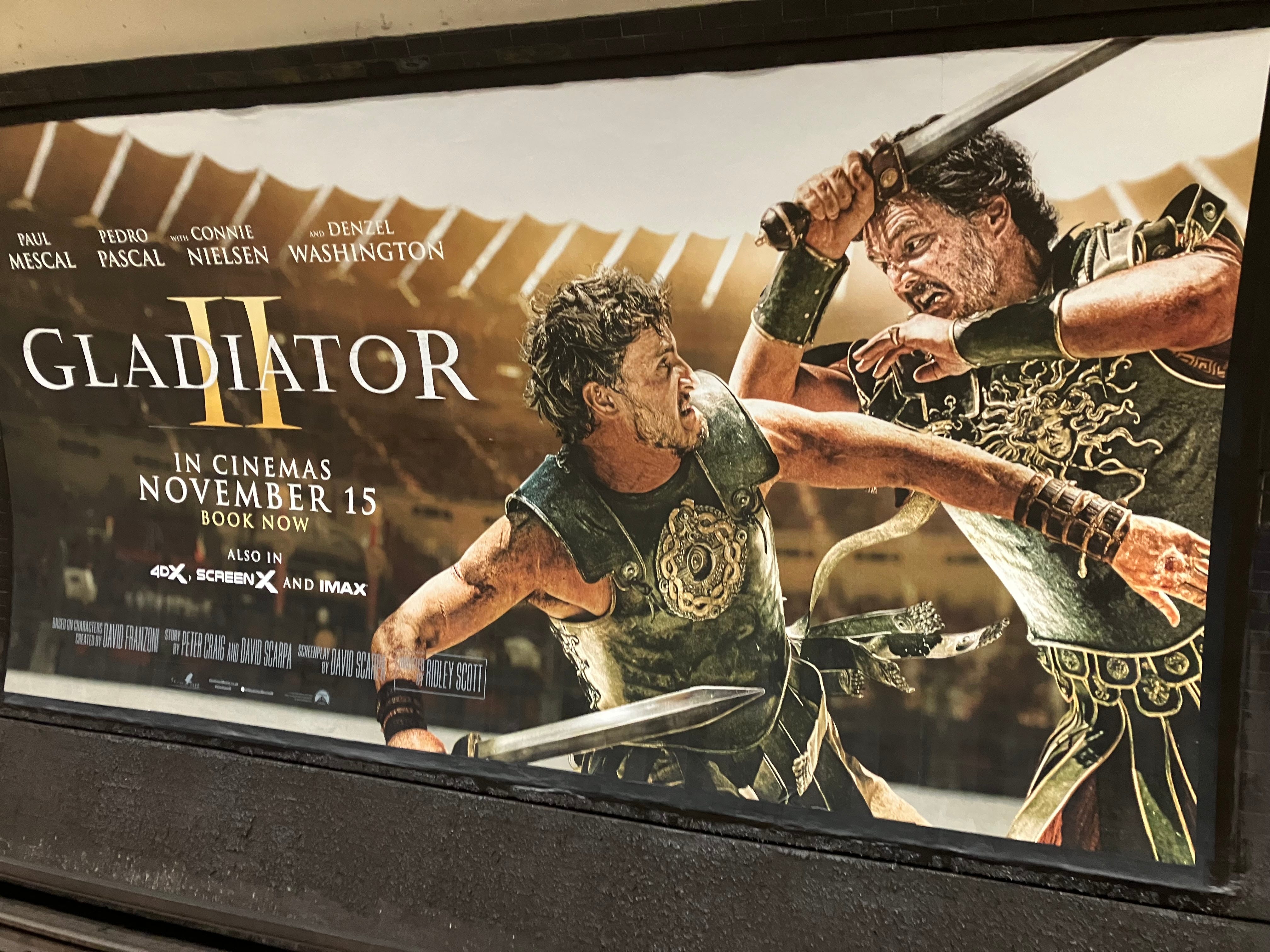
Look, before we begin, let’s be quite clear about something. There’s no joy to be had in bludgeoning (alas, only in the literary sense) a man who has just been trampled by a rhino. A reviewer derives no pleasure from queuing up alongside everyone else to thrust his gladius into our latter-day Caesar, who was once so brilliant, but has now made one atrocious film too many and must receive his grisly comeuppance. No. Like a good gladiator, the good reviewer hopes to find his or her opponent in at least reasonable health at the time of battle, if only to provide a better spectacle.
How fortunate, then, to discover Ridley Scott — fresh from delivering to our screens his much anticipated Gladiator sequel — not lying, broken, in a widening pool of furious criticism, but basking instead on a sun lounger of reckless indulgence. The Guardian pronounced Gladiator II a ‘thrilling spectacle’. ‘Relentlessly entertaining’, gushed The Telegraph. The film buffs over at Empire awarded the sequel four stars out of five, dubbing it ‘a hell of a ride’. Poring over these shameful puff pieces, struggling to convince myself that we’d all seen the same film, my attention is rocked by a fresh scandal. Ridley Scott, it turns out, might not be content to settle for one sequel, and in fact is seriously considering making a third Gladiator film.
At this the horn of war blasts in my ears: I can restrain myself no longer. I unsheathe my quill, rub it clean on my leather belt, and dip it into the inkpot. I rub my hands in the dust and blow on them for luck. I write the words: “Gladiator II opens with...”
Gladiator II opens with an artistic, mood-establishing montage of shots from the first film, set to the wailing strains of the original’s transporting soundtrack. The innocent cinema-goer shivers in their chair, transfixed, and perhaps wipes away a tear. Jesus, Ridley (you whisper), you’ve still got it, you old son of a gun. When, two or three minutes later, the film begins in earnest, the innocent cinema-goer — having sufficiently scratched the nostalgic Gladiator itch — should get up and make for the exit. But of course it’s too late for that, the die has been cast, and we’re sufficiently intrigued to hang around for what comes next.
The answer, sadly, is: barely anything of any substance. We meet our hero, Lucius (Paul Mescal), who seems a dull sort. Lucius is a Numidian, and a Maximus look-and-dress-alike. His relationship with his wife is one of those only-on-TV relationships where one gets the sense that, in all their years of marriage, they’ve never once shared a joke. No, all they’ve ever done is gaze tempestuously into the distance, murmuring enigmatic phrases to each other along the lines of ‘I am here, and you are there, and so it will be always.’ Happily enough, we aren’t obliged to suffer this romance for too long, as Lucius’ wife is topped by some marauding Romans about five seconds into the curtain-raising action sequence, leaving her widower railing bitterly at the evil that is Rome, and free to begin his unlikely (and immensely convoluted) journey to the Colosseum.
Before, however, he can play to the baying crowds of Rome’s greatest arena, our hero (like Maximus before him) is obliged to make a name for himself. His opportunity comes along soon enough, at a grotty backwater just outside Rome. It will be a fight to the death, but not as we know it, for rather than other slaves, or even other gladiators (both options presumably dismissed out of hand as too boring for modern audiences), our hero is forced to take on a menacing pack of computer-generated baboons… Around here I began to resign any expectations I might still have been harbouring about the film. With a sort of sigh of puzzlement I watched Lucius monkey around with his slave-chains for a while, before neutralising the only baboon who could be bothered to do any fighting with, um, a bite to the leg. In so doing, Lucius secures the interest of Macrinus (Denzel Washington) — a social climber with aspirations of Emperordom and a transparent rehash of Oliver Reed’s Proximo from film one. Watching keenly from the ramparts, Macrinus apparently sees in Lucius an ungovernable rage that he can exploit for his own sinister ends — ends which, incidentally, are never fully realised or explained to the audience. Macrinus’ excitement about Lucius’ battle-hardiness is also at odds with that of the audience, who by this point, a mere half hour into the film, have seen Lucius soundly trounced in the opening battle (against the Romans) and only narrowly survive the second one (against the baboons).
Anyway, Macrinus snaps up his new gladiator on a free transfer and carts him off to Rome to make the big time. Here the viewer briefly goes dewy-eyed again, for who should appear but Lucilla (Connie Nielsen), the steely feminine epicentre of film one, deftly treading the line between her brother Commodus’ incestuous advances, and her duty to Rome (and Maximus). But what’s happened here? Gone is the hard-bitten, gutsy Lucilla we thought we knew, replaced by a waif-like bore who mopes and pines about the place — every line of dialogue a throwaway — pondering the fate of her long-lost son Lucius and harping on about her father Marcus Aurelius’ “dream of Rome”. This intangible (and very quickly unbearable) refrain is immediately taken up by the rest of the cast and used to clout the audience about the head whenever there’s a lull in the action.
Anticipating, perhaps, that we are running short of antagonists whose deaths we can guiltlessly root for, Ridley Scott rushes to introduce some villains. Enter twin emperors, Geta and Caracalla. Facile, trite, and (worst of all) boring, the sinister siblings do nothing quite so effectively as mirroring the prevailing mood of the film. As it turns out, neither of them dies at the hands of our hero anyway, reducing their presence in the script to a sort of sideshow. There are a lot of other sideshows, too. A battle between some gladiators and a rhino the size of a double-decker bus. A battle between some gladiators, featuring Great White sharks swimming around inside the Colosseum. A battle between some gladiators and their slave-masters… And so it continues, over and over, each bloodbath more far-fetched than the last.
At no point in any of these battles are we invited to feel the faintest emotional investment (or sense of jeopardy) about their outcome. We’re never introduced to any of the other gladiators, so we just shrug wearily when their time comes to be impaled, or bitten in half, or decapitated. We never understand why the Emperor twins are so pointlessly evil, so we don’t care when one of them lops off the other’s head. We do understand that Lucius is upset over the death of his wife, but after he forgives his wife’s killer Acacius about halfway through the film, what is there left for him to do? Robbed of his chief motivation, he drifts uneasily through the remaining hour, casting around for a new character arc, latching on at last (unconvincingly) to the ‘dream of Rome’, which is still doing the rounds like a mind virus. Strange, since only a short while has passed since he hated Rome and all it stood for.
The inconsistencies continue to stack up, quickly threatening to outmanoeuvre whatever coherence the original script might once have had. In a bid to avoid being outflanked, director and scriptwriters turn their beady eyes on the first film, and commence a large-scale plundering operation. The operation starts small-scale — the odd phrase here, the odd reference there — but soon becomes brazen, shameless, desperate. Entire sequences, unchanged from the original, are lifted and reshot: gladiators chanting ‘strength and honour’, Maximus trailing his fingers through fields of corn, Lucius rubbing his hands in the dust. Intended initially, no doubt, as an homage to the first film, these motifs are endlessly recycled to the point that, after a while, the dazed audience can’t remember what they signified in the first place. Of the first film’s many memorable quotes, perhaps none are used and abused in Gladiator II quite as violently as ‘what we do in life echoes in eternity’, which in the space of about fifteen minutes devolves into a social media-style slogan, shorn of all force and meaning.
Elsewhere, bizarre, clunking moments proliferate. Early on, there’s a longish interlude in which Lucius applies a splint to the broken arm of his Numidian friend; we sense that this friend may yet develop into a character of some importance: in the next scene he is abruptly torn apart by one of the CGI baboons. Later, and throughout the film, Lucius / Mescal adopts Maximus’ gruff laugh and deploys it like a bad impression at moments that don’t seem to merit laughter. Later still, towards the chaotic and incoherent dénouement, legendary stage actor Derek Jacobi (alongside Nielsen, one of the only remaining cast members from the first film) is done away with so perfunctorily that he might have been a demanding extra Ridley Scott was sick of seeing turn up on set.
Finally, mercifully, the credits roll. Trying not to think of all the better ways you could have spent the evening, and keeping your head down in case someone asks you whether you enjoyed it, you stumble for the exit. A small blessing, but one of Gladiator II’s strengths is that it’s too forgettable to weigh you down for long.
Later, much later, in philosophical mood, you find yourself asking: was I rooting for anyone, back there, among the popcorn and the Coca-Cola? Certainly not for Lucius. Nor, on reflection, for Macrinus, the film’s ultimate antagonist, whose motivations the scriptwriters refused to reveal (or come up with), thus preventing him — despite Denzel Washington’s best efforts — from becoming that rarest of beasts: a developed character.
No, maybe, after all, you were rooting for Ridley Scott, who in his original Gladiator gave us a good-versus-evil masterpiece for the ages. Believable, gripping, vivid, it set your blood on fire and squeezed your heart until it ached. That he couldn’t repeat the feat (or come anywhere near it, really, in this dimwitted, broken-horned rhino of stupidity) was hardly a surprise, but oh, how badly we wanted him to! Our one-time champion, our journeyman retiarius — with his three-pointed trident, his weighted net, his manly brow — who, twenty-four years ago, showed us all his own dream of Rome, and set the gold standard for epic filmmaking at the dawn of a new millennium.