
28 Years Later: The Bone Temple
Director: Nia DaCosta

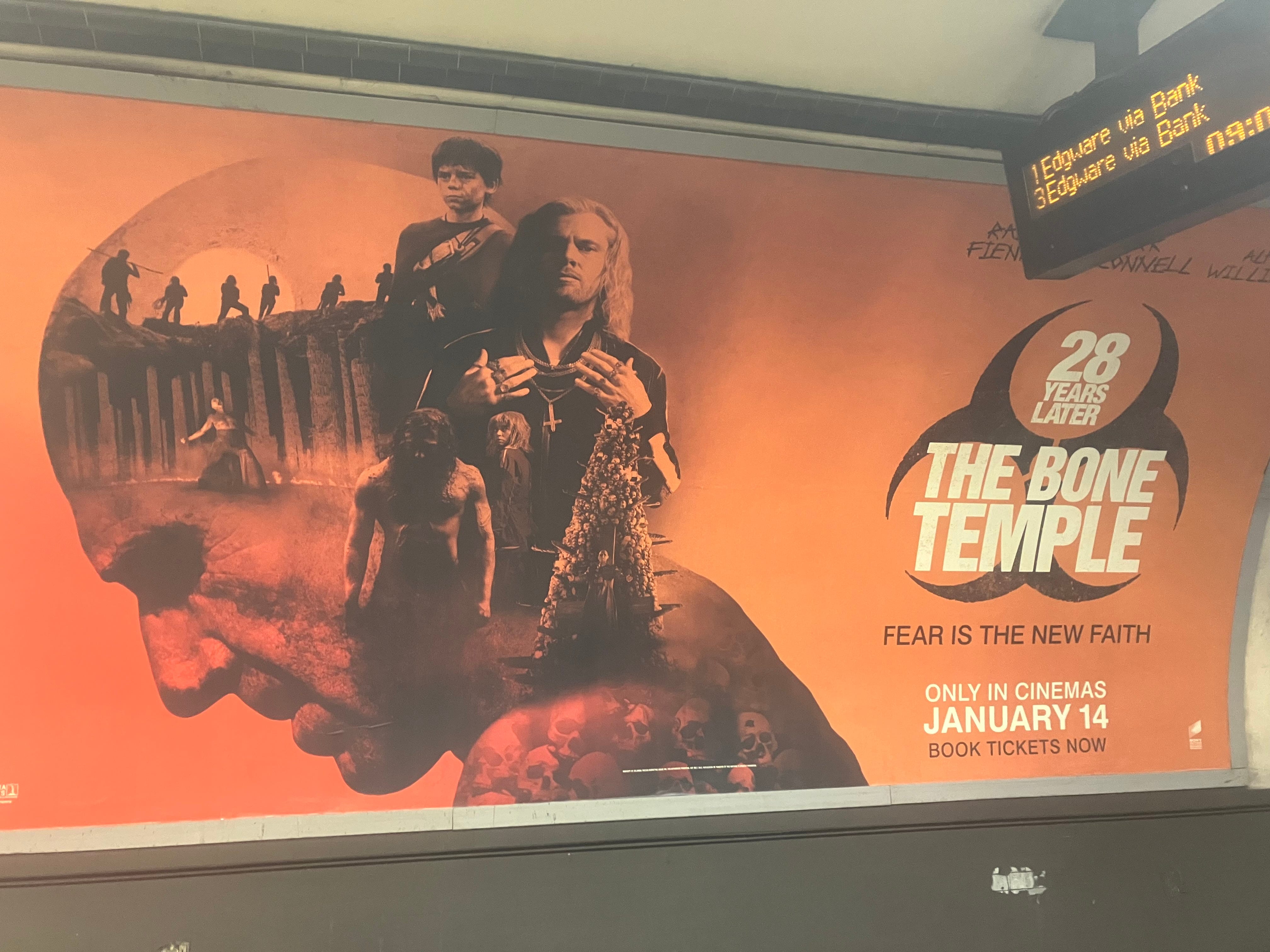
The opening scene of the latest 28 Years Later sequel could perhaps provide pain psychologists with an effective litmus test for human tolerance to on-screen violence. Oh, I’d heard in advance that the film would be gory. Mega-gory. Which is why, dear and valued reader, I did the same thing anyone sensible might have done. Rolled my eyes, swaggered into the theatre with my popcorn, and, within seconds, had one hand covering my eyes and the other checking over my various limbs to ensure they were still attached. Do other people do this? Do you do this? Reflexively hug yourself when someone’s arm get hacked off on the big screen? Cross your legs and pull a queasy face (as though on the character’s behalf) when they take a flick-knife to the inner thigh? No, no, of course not. Me neither…
What exactly was I expecting from an 18-certificate zombie flick, you may well ask? Well, I had girded myself for the devouring of brains, the squelching of intestines, and so on. Zombie violence, in other words. I hadn’t prepared myself mentally — and here The Bone Temple broaches interesting new territory — for human violence on such a visceral scale as to make the zombie stuff feel like light relief.
Anyway, the hair-and-curtain-raising opening sequence picks up more or less where the first film left off. Pre-adolescent hero, Spike (the superb Alfie Williams), has fallen in with a sort of Platonic ideal of the wrong crowd. His new brethren are a cult of tracksuit-wearing, knife-wielding, peroxide-wigged Satanists, who all go by the name ‘Jimmy’, and delight in the sight of blood, and generally make the pickpocketing hoodlums in those AI-generated “London is cooked” videos doing the rounds on social media look like the Teletubbies. Nomadic and fearless, they (the Satanists, not the Teletubbies) roam the wastelands, languidly eviscerating zombies as they go, searching for pockets of survivors on whom to inflict ritualistic depravities they call “charity”.
Cult leader Jimmy Crystal (Jack O’Connell) wears an inverted cross and a smile eerily reminiscent of a notorious namesake. His command over the (largely teenage) cult, whom he refers to as his “Fingers”, is total. Shunning the actual perpetration of violence himself, he whips up his Fingers into a frenzy with his florid rhetoric, regurgitating bastardised, pseudo-Biblical ideas interspersed with his own wild, chaotic theories. Unpredictable, demagogic, and oozing a darkly sexual menace, the self-styled “Sir Lord” Jimmy Crystal is an antagonist tailor-made for our times.
Meanwhile, and from the relative safety of his ‘ossuary’ — the titular “Bone Temple” — Dr Ian Kelson (Ralph Fiennes) continues to eke out an existence. By night he studies the zombie infection to the music of his gramophone; by day he burns the dead and decks out his lawn with their bones. Long-time subscribers (and I value and cherish all of you a great deal) may recall my being rather dismissive of the good doctor in my review of the first 28 Years. But I also correctly surmised that we would be spending more time in his company in this instalment, and, as a counterpoint to the ghoulish Jimmy Crystal and his Fingers, Kelson makes an increasingly joyous companion.
Kelson, aping Robert Neville in Matheson’s I Am Legend, believes himself on the cusp of a scientific breakthrough. A monstrous Uber-zombie (see earlier, well-written review for explainer), whom the doctor christens Samson, has become hooked on the sedative blowdarts with which Kelson defends himself. Over time, Samson becomes so crazily addicted that he becomes a regular fixture at Kelson’s temple (if you are detecting religious overtones from this storyline, who am I to disabuse you?) baring his chest for an ampoule of morphine. As Samson’s visits become more and more frequent, so Kelson takes greater and greater personal risks in a bid to pierce the zombie-fog that he believes to have only clouded (rather than destroyed) a brain which, he speculates, may yet remain essentially human. Kelson’s race to complete his studies is complicated not only by his dwindling drug supplies, but by the steady approach of Jimmy Crystal and his Fingers, who, spying the temple in the distance, have decided it might be worth a visit…
Far from the lacklustre money-spinner I had feared, this latest adornment to the 28 Days pantheon has much to recommend it. Rarely has Satanism looked so chillingly believable: an apocalyptic ideology granting a group of scared, impressionable children permission to inflict terror for a cause, no matter how crude or illusory, rather than suffer that same terror themselves. Among their ranks Spike cowers in fear, lost and alone, an unwilling disciple of a movement he doesn’t believe in, yet against which he is utterly powerless.
In this sense, we see Spike beginning to resemble Cillian Murphy’s ‘Jim’ from the original 28 Days Later. Like Jim, Spike has an idea of what ‘civilised’ life used to be like, if only on his medieval island (of which, incidentally, there is no mention in The Bone Temple). However, this is now a distant memory, as Spike finds himself physically and spiritually deracinated, grasping vainly to find anything permanent or reliable in a cruel and alien world.
But The Bone Temple's real power lies in the latent, and finally real, conflict between Crystal and Kelson. O’Connell and Fiennes both turn in hard-hitting, compelling performances. Without giving too much away, one of the film’s best scenes is when they first meet: breathing the same air, speaking the same language, apparently, even, getting on with each other — but diametrically opposed. All the time you feel Kelson’s fear alongside him. Shorn as we are, in this desolate antiterra, of fundamentally “good” characters, Kelson comes into his own in a gripping and uplifting finale, metamorphosing from Kurtz to Christ, a symbol of all the good humans can still do for one another, no matter how lost we may feel, or how bleak the world around us.